
Can Credit Card Companies Take Money Out Of My Bank Account Without My Permission in Connecticut?
If you are faced with credit card debt, it is understandable to worry about whether a creditor can directly reach into your bank account. Many people facing financial difficulties ask, “Can credit card companies take money out of my bank account without my permission in Connecticut?” While they usually cannot do so, the skilled attorneys at Ambrogio, Pletter & Associates, LLC can help you better understand your current financial situation and its legal implications.
What Happens When You Stop Making Payments on a Credit Card?
When you stop paying a credit card, the first step in the collection process is for the credit card company to call you and send you collection letters. These calls and letters get increasingly aggressive and nasty as time goes by. They may even tell you that you can be arrested for not paying your credit card debt. This is not true and it violates the law for them to say it as a scare tactic.
There are several law firms in the State of Connecticut that represent the credit card industry. These law firms file suit against delinquent credit card holders.
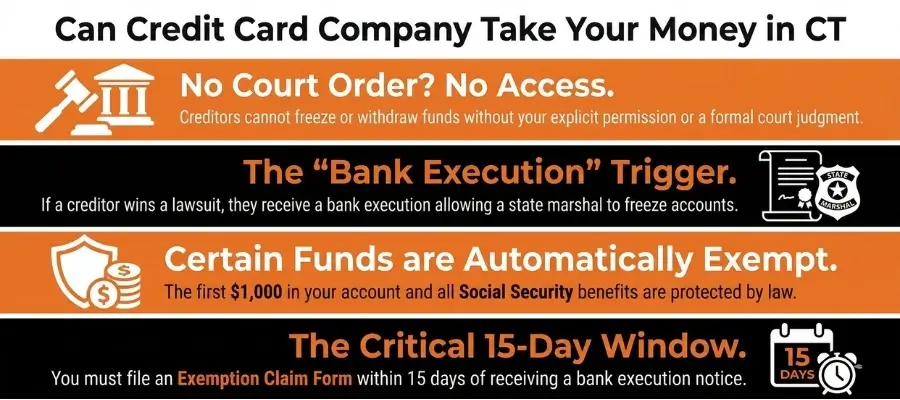
If calling and writing letters does not scare you into paying, the credit card company will file a lawsuit against you. You will be served a summons from a marshal. You can try to defend the suit, but if you owe the money, the chances of winning the suit are low. If the credit card company wins the lawsuit, they will obtain a judgment against you. The judgment is very powerful because it allows the credit card company to take money from you without your permission.
The court will give the credit card company a bank execution. A bank execution allows a state marshal to go to all of the banks in the state and if you have any money in those banks, the marshal can freeze that money. If you receive notice of a bank execution it is not too late to protect the money in the bank. The bank will give you a form, which allows you to claim the money in the bank account as exempt.
The form is called Exemption Claim Form Bank Execution. It can be found on the Connecticut Judicial website as form JD-CV24a. A creditor cannot take your last $1000, so if you have $1000 or less in the account, you can protect it. If the money in the account comes from Social Security, that is exempt as well. You only have 15 days from the mailing of the Exemption Claim Form to claim the money in the account as exempt.
You should also file the form with your bank. After you file the form with the court, you will receive a hearing date. If you file bankruptcy during this 15 day window, the credit card company will not be able to take the money from your account. In most cases you can protect up to $10,000-$12,000 per person in your bank account if you file a Chapter 7 bankruptcy.
If you receive a bank execution, Attorney Tim Pletter can help you fill out the Exemption Claim Form. He can also tell you if filing for bankruptcy is a good idea.
When Are Credit Card Companies Unable to Take Money From Your Accounts?
In many cases, a credit card company cannot take money from your bank account without your permission. Credit card insurers do not have immediate access to your checking or savings accounts just because you owe a balance.
Without consent, a creditor typically cannot:
- Take funds straight from your bank account
- Freeze your account as it is
- Withdraw money without an order from the court
If a withdrawal takes place without authorization or a legitimate legal basis, it can violate consumer protection laws.
When Can Credit Card Companies Access Your Bank Accounts in Connecticut?
There are a few situations where money can legally be taken from your bank account in Connecticut, and even when it is, it is not usually the credit card company accessing your account directly. The main scenarios that allow a credit card company or legal personnel to take money directly from your account include:
- Authorized payments
- Wage or bank account garnishment
The process usually calls for a claim filed in court, a judgment brought forth against you, and a court-approved garnishment order. By that time, a bank can be required to turn over or freeze specific funds.
The Next Step: Work With a Wage Garnishment Lawyer
So far this year, American citizens carry a collective credit card debt of $1.21 trillion. When creditors elevate efforts for collection, timely legal counsel makes a difference. If you team up with a wage garnishment lawyer, they can review court paperwork, determine the lawfulness of garnishment, and help you take action before further funds are taken. Don’t wait to see how the skilled attorneys at Ambrogio, Pletter & Associates, LLC can help you.
FAQs
Can a Credit Card Company Take Money From Your Bank Without Permission in Connecticut?
No, a credit card company generally is not allowed to take money from your bank account with your conscious authorization in Connecticut, unless it has received a court judgment and abided by standard garnishment procedures. If you’re unsure whether a credit card company is withdrawing funds legally, you should take action by speaking with a member of Ambrogio, Pletter & Associates, LLC.
How Can I Stop a Debt Collector From Garnishing My Bank Account in Connecticut?
Preventing the garnishment of your bank funds can involve contesting the judgment, highlighting exemptions, or satisfying the debt through other legal avenues. Taking legal action in a quick, timely manner is vital, especially when the order for garnishment is ordered and approved by the court. A wage garnishment attorney can help you understand your rights and work to stop wage garnishment procedures.
Can You File a Claim Against a Company for Taking Money Out of Your Account Without Permission?
In certain situations, you may be able to file a civil claim against a company for taking money out of your account without permission. Improper collection practices or unauthorized withdrawals can lead to legal claims, depending on the applicable laws and the specific circumstances. An attorney from our firm can determine the most effective legal strategy for your case and whether you have grounds for a civil claim.
When Should You Consult a Wage Garnishment Lawyer?
If you are experiencing all-encompassing debt that has now led to wage garnishment, it’s imperative that you work with a wage garnishment lawyer as soon as possible. A knowledge wage garnishment lawyer has the knowledge, resources, and negotiation skills needed to help you find the most effective resolution to your scenario while protecting your rights throughout proceedings.
Contact Ambrogio, Pletter & Associates, LLC Today
Being faced with debt collection can be terrifying, especially when your savings or income are in danger. The first step to regaining control is understanding your rights, which is why you should contact Ambrogio, Pletter & Associates, LLC today to figure out what possible actions are available to your situation.
Take Action Today & Begin Moving Forward
Attorney Tim Pletter works directly with his clients, and most of your contact will be directly with him. Please contact our Stratford, Connecticut, office today to arrange your free consultation

© 2026 Ambrogio, Pletter & Associates, LLC • All rights reserved.
Digital Marketing By: 
*Images are obtained under license from Canva and other third-party stock image providers, with attribution included where required.